
Supplier Evaluation
Design Support for Aluminum Extrusions: What Automotive and EV Engineers Should Expect From a Supplier
How to evaluate an aluminum extrusion supplier's design support: what each engagement stage should cover, the profile issues a good supplier catches before RFQ, and the questions to ask before committing.
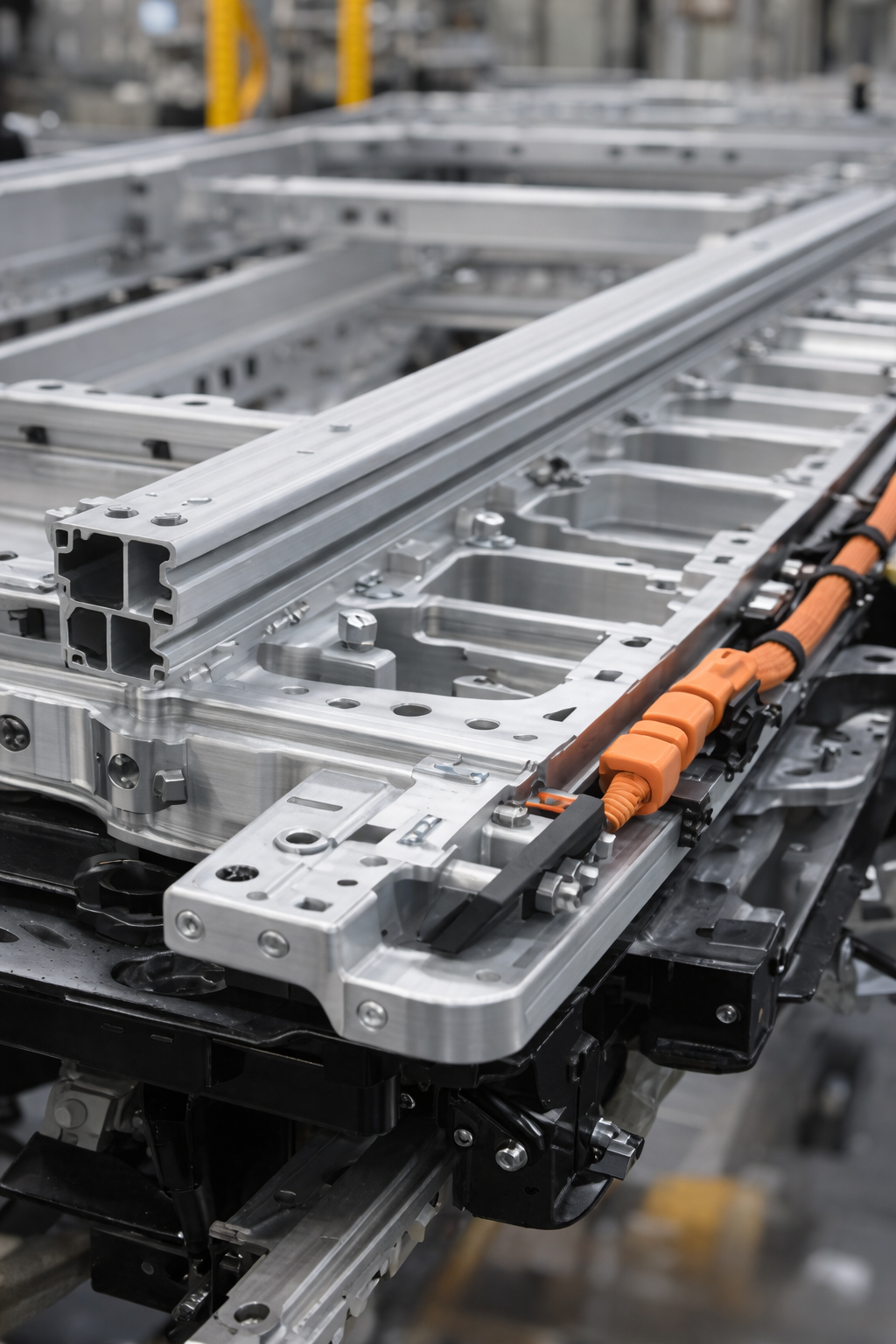
Aluminum content per vehicle has been climbing steadily as automakers and EV manufacturers work to offset battery mass and meet efficiency targets. The Aluminum Association projects average aluminum content in North American vehicles will reach 514 lb by 2026 and 570 lb by 2030.
Extrusions are central to that growth, showing up in battery enclosures, structural frames, crash management systems, seat rails, and motor housings. That shift raises the stakes on every extrusion decision. In a conventional program, a poorly designed profile creates rework costs and schedule pressure. In an EV program, where structural and thermal performance are tightly integrated and tooling lead times are already compressed, the same mistake can delay a launch.
The supplier selection decision should reflect this. Piece price matters, but it is not the only variable that affects program cost. The engineering involvement a supplier brings before RFQ, before tooling, and before sampling is where real risk is managed.
What Strong Extrusion Design Support Actually Includes
Most supplier pages describe design support as a list of services. That framing is useful for marketing but not very useful for engineering evaluation. The more practical question is: at what stage does the supplier engage, and what specifically do they review?
Strong design support starts at concept, not at quotation. It covers the full profile life cycle, from initial geometry through extrusion feasibility, alloy selection, tolerance strategy, die development, and downstream process compatibility. A supplier who only reviews the extrusion step in isolation is missing the majority of where cost and risk actually live.
What Each Stage Should Cover
| Stage | What a strong supplier reviews |
|---|---|
| Concept review | Profile geometry, extrusion feasibility, die complexity, wall balance |
| Alloy and temper selection | Extrudability, strength, machinability, bendability, finishing compatibility |
| Tolerance strategy | Which dimensions are function-critical vs. over-specified; cost implications |
| Die development | Wall thickness transitions, tongue ratios, thermal flow, draft angles |
| Downstream integration | Machining setups, fabrication steps, weld or join requirements, anodizing or coating readiness |
| Prototype and sampling | Sampling plan, first-article inspection criteria, production-readiness checks |
The integration column matters most in automotive and EV programs. A profile designed without considering downstream machining may require additional fixturing, extra cuts, or tolerance re-evaluation after sampling. A profile not reviewed for finishing compatibility may show streaking, uneven anodize penetration, or surface defects on visual components.
Prototype planning and sampling strategy should be part of the engineering engagement, not a separate conversation that happens after die approval.
The Design Issues a Good Supplier Should Catch Before RFQ
This is where the difference between a supplier who “does design support” and one who genuinely practices it becomes visible. A supplier offering real pre-RFQ review will raise specific technical concerns, not just approve the drawing and proceed to tooling.
The following are the categories of issues that should be identified and resolved before a die is cut.
1. Wall Thickness and Transition Problems
Significant variation in wall thickness across a profile creates uneven metal flow during extrusion. This leads to distortion, dimensional inconsistency, and higher scrap rates. As a general design principle, adjacent wall thicknesses should stay within approximately a 2:1 ratio, and transitions should be radiused rather than sharp. A supplier who does not flag these issues before tooling will surface them during sampling, at significantly higher cost.
2. Over-Specified Tolerances
Tight tolerances are appropriate for functional fit dimensions. They are not appropriate everywhere. A profile with uniformly tight tolerances across all features increases die complexity, slows production, raises inspection burden, and can make the part commercially unviable at volume. A strong supplier will identify which tolerances are driving cost without driving performance and recommend a selective tolerance strategy aligned with actual functional requirements.
3. Alloy and Temper Mismatches
The 6000-series alloys used in most structural and automotive extrusion applications each have different trade-offs. 6061 offers higher strength and machinability. 6063 extrudes more cleanly and produces better surface finish for anodizing. 6005A is common in structural profiles requiring a balance of strength and extrudability. Temper selection affects bendability, weldability, and heat treatment requirements. If alloy and temper are not reviewed against the full application, including downstream processing and finishing, problems appear late.
4. Multi-Feature Profiles That Should Be Simplified or Split
Complex multi-feature profiles are one of the real advantages of aluminum extrusion. But complexity has a threshold. A profile that integrates too many features in a single die may create flow imbalance, require expensive die corrections, or produce inconsistent geometry. A good supplier will evaluate whether a complex profile is worth simplifying, splitting into two interlocking extrusions, or redesigning to reduce die risk and improve production consistency.
Why Early Supplier Collaboration Lowers Total Cost, Not Just Piece Price
The comparison most engineers make at RFQ is piece price. That comparison is incomplete. The profile cost is one line item. The total program cost includes tooling, sampling iterations, secondary machining, assembly steps, inspection burden, and the cost of late-stage engineering changes if problems surface after tooling begins. Early design collaboration affects nearly all of those categories.
Where Cost Reduction Actually Happens
Part consolidation. Aluminum extrusion can integrate features that would otherwise require separate components, fasteners, and assembly operations. A well-designed profile that replaces a welded subassembly or a multi-part bracket reduces BOM complexity, lowers inventory, and improves repeatability. The savings are in the assembly line and the supply chain, not the extrusion price.
Reduced secondary operations. A profile designed with downstream machining in mind requires fewer setups, simpler fixturing, and less material removal. A profile not reviewed for machinability may require operations that add cost, time, and dimensional risk at every production run.
Fewer die iterations. Die rework after first sampling is a significant cost and schedule event. Most of the issues that cause die rework, including wall imbalance, unrealistic tolerances, and flow problems, are identifiable before tooling if the supplier is looking for them. Early review does not eliminate all sampling iterations, but it reduces the number driven by avoidable design decisions.
Lower timing risk. In automotive and EV programs, schedule delays have costs that extend well beyond the tooling invoice. Late-stage redesigns can push start-of-production dates, trigger supplier re-qualification, and create ripple effects across dependent systems. Early design engagement is one of the few levers that reduces timing risk before it materializes.
The real cost comparison is not supplier A's piece price vs. supplier B's piece price. It is total program cost with early engineering involvement vs. total program cost without it.
What Engineers Should Ask an Extrusion Supplier Before Committing
Design support is easy to claim and hard to evaluate from a supplier's website. The best way to assess it is through direct conversation before RFQ. These questions are designed to surface how a supplier actually operates, not how they describe themselves.
On geometry and feasibility
- How do you review a profile for die feasibility, wall balance, and flow considerations? At what stage in the process does that happen?
- Can you walk through a recent example where you recommended a geometry change before tooling?
On tolerance and alloy strategy
- How do you approach tolerances on a new profile? Do you flag dimensions that appear over-specified relative to function?
- How do you select alloy and temper for automotive or structural applications, and how does downstream processing factor into that recommendation?
On downstream integration
- Can you support the full process in-house, including machining, fabrication, and finishing? If not, how do you coordinate with downstream suppliers to ensure the profile is designed for the full process?
- How do you handle surface-critical or cosmetically visible profiles that require anodizing or coating?
On automotive and EV experience
- What extrusion work have you done for automotive or EV applications? What were the specific design challenges and how were they resolved?
- How do you approach lightweighting requirements where structural performance and minimum wall thickness are both constrained?
A supplier who can answer these questions with specifics is demonstrating the kind of engineering depth that reduces risk. A supplier who answers with generalities is telling you something important about how they operate.
Why Dajcor Fits This Evaluation Framework
Dajcor's value in an automotive or EV program is not extrusion capacity alone. It is the combination of collaborative design engineering with in-house machining, fabrication, and anodizing that makes early involvement meaningful. When the team reviewing your profile also handles downstream processing, design decisions get made with the full manufacturing picture in view, not just the extrusion step.
That integration matters for the specific challenges automotive and EV engineers face: lightweighting targets that require minimum-weight profiles without sacrificing structural performance, complex multi-feature designs where die feasibility and downstream machinability have to be considered together, and surface-critical applications where finishing compatibility has to be built into the profile from the start.
The best moment to involve Dajcor is before RFQ, when the geometry is still being defined and changes cost nothing. That is when design support has the most leverage on tooling cost, sampling cycles, secondary operations, and program timing.
Frequently asked questions
Before RFQ, while the geometry is still being defined and changes cost nothing.
A supplier who waits for a finalized drawing has missed the window where geometry, tolerance, alloy and process issues can still be corrected inexpensively. Early engagement is one of the few levers that reduces timing risk before it materializes.
The Aluminum Association projects average aluminum content in North American vehicles will reach 514 lb by 2026 and 570 lb by 2030.
Extrusions are central to that growth, appearing in battery enclosures, structural frames, crash management systems, seat rails and motor housings.
As a general design principle, adjacent wall thicknesses should stay within approximately a 2:1 ratio, and transitions should be radiused rather than sharp.
Significant variation in wall thickness creates uneven metal flow during extrusion, which leads to distortion, dimensional inconsistency and higher scrap rates.
It depends on what the profile has to do. 6061 offers higher strength and machinability. 6063 extrudes more cleanly and produces a better surface finish for anodizing. 6005A is common in structural profiles requiring a balance of strength and extrudability.
Temper selection also affects bendability, weldability and heat treatment requirements, so alloy and temper should be reviewed against the full application including downstream processing and finishing.
The profile cost is one line item. Total program cost includes tooling, sampling iterations, secondary machining, assembly steps, inspection burden, and the cost of late-stage engineering changes if problems surface after tooling begins.
Early design collaboration affects nearly all of those categories, so the real comparison is total program cost with early engineering involvement versus without it.
Profile geometry, extrusion feasibility, die complexity and wall balance.
Strong design support then continues through alloy and temper selection, tolerance strategy, die development, downstream integration, and prototype and sampling planning.
Related to this article
Where this comes up across our capabilities and the markets we serve.