
Design Guides
Custom Aluminum Extrusions for Medical Devices: A Design Guide for OEM Engineers
What OEM engineering teams need to evaluate when specifying custom aluminum extrusions for medical devices: alloy selection, tolerances, surface finishing, secondary machining and compliance.

When medical device engineers specify materials for a new component, the stakes are high. A wrong alloy choice, a surface finish that traps bacteria, or a tolerance stack-up that fails assembly review can send a project back months. That pressure is exactly why custom aluminum extrusions have become a go-to solution for OEM design teams working on everything from diagnostic imaging frames to surgical instrument housings.
Aluminum extrusions offer something rare in medical device manufacturing: a near-net-shape process that delivers complex cross-sections in a single operation, with tight tolerances, excellent strength-to-weight ratios, and surface finishes that meet healthcare cleanliness requirements. Canada's medical device manufacturing industry is valued at approximately USD 6.6 billion in 2026, and the demand for precision, lightweight components continues to grow as devices become more compact and portable.
This guide covers what OEM engineering teams need to evaluate when specifying custom aluminum extrusions for medical device applications: alloy selection, tolerance and geometry considerations, finishing requirements, downstream fabrication, and the compliance questions that come up early in the design process.
Why Aluminum Extrusions Work Well in Medical Device Applications
Aluminum has been used in medical equipment for decades, and the extrusion process amplifies the material's natural advantages for this sector. The core appeal is manufacturability: a well-designed extrusion profile can consolidate features that would otherwise require multiple machined parts, reducing assembly complexity and part count.
Strength-to-weight ratio is the most cited reason OEM teams reach for aluminum. At roughly one-third the weight of steel, 6000-series aluminum alloys deliver structural performance that satisfies load-bearing requirements in device frames, trolley rails, and equipment enclosures without adding mass that affects portability or ergonomics.
Common Medical Device Applications
Custom aluminum extrusions are specified across a wide range of medical device categories:
- Imaging equipment frames and gantries (CT, MRI, X-ray): structural members that need dimensional stability and low magnetic permeability
- Surgical instrument handles and housings: complex profiles that integrate grip geometry, channel routing, and assembly features in one extrusion
- Patient monitoring and IV pole systems: lightweight structural extrusions with integrated track or slot features for accessory mounting
- Diagnostic device enclosures: thin-wall profiles that provide EMI shielding potential and cleanable surfaces
- Rehabilitation and mobility equipment: load-bearing structural profiles where weight reduction directly affects patient usability
- Sterilization trays and instrument organizers: corrosion-resistant profiles designed for repeated autoclave or chemical sterilization cycles
The Near-Net-Shape Advantage
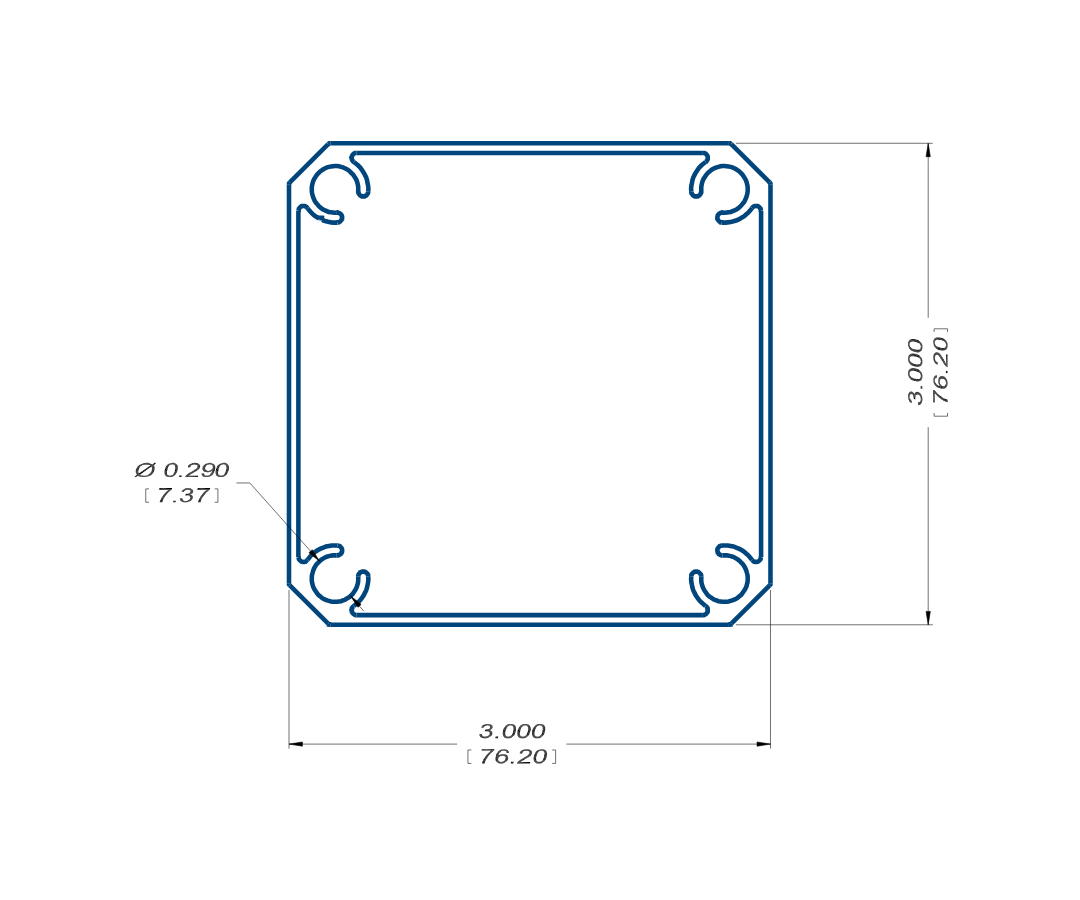
The extrusion process produces profiles that are close to final geometry before any secondary operations begin. For medical OEMs, this matters for two reasons: it reduces the amount of material removed during precision machining, which lowers per-part cost, and it allows complex internal channels, mounting slots, and wall geometries to be built into the profile from the start.
A T-slot channel, a cable routing groove, or an integrated hinge feature that would require multiple machining setups on a billet can be extruded in a single pass. That kind of design consolidation reduces both manufacturing lead time and the risk of tolerance stack-up across assembled components.
Alloy Selection for Medical Device Extrusions
Not every aluminum alloy is appropriate for medical device applications. Biocompatibility, corrosion resistance, surface finish quality, and machinability all factor into the decision. The medical industry primarily relies on three alloys that have passed biocompatibility testing under standards like ISO 10993: 6061, 6063, and 3003.
| Alloy | Strength | Surface quality | Best use cases |
|---|---|---|---|
| 6061-T6 | High | Good | Structural frames, load-bearing components, device housings under mechanical stress |
| 6063-T5/T6 | Medium | Excellent | Aesthetic enclosures, handrails, diagnostic frames, surfaces requiring anodizing |
| 3003 | Low–Medium | Good | Fluid channels, non-critical structural parts, lightweight interior components |
6061: The Structural Workhorse
6061 is the default choice when mechanical performance is the primary driver. Its tensile strength in the T6 temper (approximately 310 MPa) makes it suitable for device frames, gantry structures, and load-bearing rails where deflection and fatigue resistance matter. It machines cleanly, welds well, and accepts anodizing reliably.
The trade-off is surface quality relative to 6063. For components that will be highly visible or require a very smooth anodized finish, 6061's slightly coarser grain structure can show more surface texture after anodizing.
6063: The Finishing-First Alloy
When surface appearance and finish quality are critical, 6063 is the preferred choice. Its finer grain structure produces smoother extruded surfaces, which translates to better anodized finishes and easier cleaning in clinical environments. It is widely specified for patient-facing components, equipment enclosures, and any profile where the surface will be visible and subject to regular disinfection.
6063 offers slightly lower strength than 6061, so it is best suited to applications where structural loads are moderate and aesthetics or cleanability are the primary requirements.
3003: Corrosion Resistance for Fluid-Contact Applications
3003 aluminum offers excellent corrosion resistance and formability, making it a practical choice for fluid channels, sterilization trays, and components that will be exposed to cleaning agents or moisture over extended service life. It is not the first choice for structural applications, but for non-load-bearing profiles in wet or chemically aggressive environments, its corrosion resistance and weldability are strong advantages.
Tolerances and Geometry Considerations
Medical device components operate within tight assembly envelopes. A profile that drifts outside its dimensional specification can cause fitment failures, misaligned assemblies, or functional issues in the finished device. Understanding what tolerances the extrusion process can reliably hold, and where secondary machining becomes necessary, is a critical part of the design conversation.
What the Extrusion Process Can Hold
Standard aluminum extrusion tolerances follow Aluminum Association standards, which specify dimensional tolerances based on profile cross-section size and wall thickness. For most medical device profiles, standard tolerances are achievable in the ±0.1 mm to ±0.25 mm range for key dimensions, depending on profile complexity.
Tighter tolerances, down to ±0.05 mm or better on specific features, are achievable through precision die design and controlled process parameters, but they require upfront collaboration between the design engineer and the extrusion manufacturer. Attempting to apply tight tolerances across an entire profile cross-section without that collaboration typically results in higher scrap rates and longer lead times.
Design Features That Affect Tolerances
Several profile geometry decisions directly influence what tolerances are achievable:
- Wall thickness uniformity: Profiles with consistent wall thickness throughout the cross-section extrude more predictably and hold tighter tolerances than profiles with large variations between thick and thin sections.
- Tongue ratios: Long, unsupported projections (high tongue ratios) are more susceptible to dimensional variation and deflection during extrusion. Minimizing tongue ratios improves consistency.
- Hollow sections: Profiles with enclosed hollow sections (requiring porthole or bridge dies) are more complex to produce and require tighter process control to maintain dimensional accuracy.
- Minimum wall thickness: For 6061 and 6063, practical minimum wall thicknesses for medical profiles are typically in the 0.8 mm to 1.5 mm range, depending on profile width and alloy.
When to Plan for Secondary Machining
For features that require tolerances tighter than the extrusion process can reliably deliver, such as bearing bores, precision hole patterns, or mating surfaces with close fits, the correct approach is to design those features as near-net-shape in the extrusion and then bring them to final dimension through precision CNC machining. This is more cost-effective than attempting to hold sub-0.05 mm tolerances across the full extruded profile.
Surface Finishing for Medical Device Aluminum Extrusions
Surface finish is not an afterthought in medical device manufacturing. It affects cleanability, corrosion resistance, biocompatibility, and in many cases, the visual quality that clinical buyers and regulatory reviewers associate with product credibility. For aluminum extrusions in medical applications, anodizing is the dominant finishing process, though the specific type and specification matters significantly.
Anodizing: The Standard for Medical Aluminum
Hard anodizing and standard anodizing both create an aluminum oxide layer on the surface that is harder than the base metal, chemically inert, and far more resistant to corrosion and abrasion than bare aluminum. For medical devices, the key advantages are:
- Corrosion resistance: Anodized aluminum resists the cleaning agents and disinfectants used in clinical environments, including many alcohol-based and quaternary ammonium compounds.
- Cleanability: The sealed anodized surface is non-porous and smooth, reducing bacterial adhesion and making it easier to wipe clean between uses.
- Hardness: Hard anodize (Type III) builds a thicker oxide layer, typically 25 to 75 microns, providing wear resistance for components that experience repeated contact or sliding.
- Colour coding: Anodizing can be applied in a range of colours, which is useful for device families that use colour coding to distinguish component types or risk levels.
Finishing Specifications to Define Early
Several finishing parameters need to be specified at the design stage, not after the extrusion is complete:
| Parameter | Why it matters for medical devices |
|---|---|
| Anodize type (Type II vs. Type III) | Determines surface hardness and layer thickness |
| Seal type (hot seal, mid-temp seal, PTFE) | Affects corrosion resistance and cleanability |
| Surface roughness (Ra value) | Impacts bacterial adhesion and cleaning protocol |
| Colour specification | Consistency across production runs for device families |
| Masking requirements | Critical for mating surfaces or threaded inserts that must remain bare |
Compliance Considerations
Medical device manufacturers in Canada operate under Health Canada's Medical Devices Regulations, and many also target FDA clearance for U.S. market access. For aluminum components, the relevant compliance questions typically involve:
- Biocompatibility testing under ISO 10993, which evaluates cytotoxicity, sensitization, and irritation potential of materials in contact with patients or users
- RoHS compliance for devices sold in the EU, which restricts certain hazardous substances in materials and surface treatments
- Material traceability and certification, including mill test reports confirming alloy composition and temper
Working with a manufacturer who understands this documentation chain, and who can provide certified material test reports, process records, and consistent lot traceability, significantly reduces compliance risk during regulatory review.
Working with a Canadian Extrusion Manufacturer for Medical Applications
For Canadian medical device OEMs, sourcing aluminum extrusions domestically offers practical advantages beyond cost and lead time. A local manufacturer can participate in early design reviews, respond quickly to design iterations, and provide the kind of direct engineering communication that matters when a product is moving through development.
Canada accounts for approximately 70.5% of North American aluminum extrusion revenue, supported by a well-developed supply chain and strong manufacturing infrastructure. That concentration means Canadian OEMs have access to capable domestic suppliers without the supply chain risk that comes with offshore sourcing for precision components.
What to Look for in a Medical Extrusion Partner
The right manufacturing partner for medical device extrusions brings more than extrusion capability. Evaluate suppliers on:
- In-house fabrication and machining: A supplier who can extrude, machine, and finish under one roof reduces handoff risk and simplifies the supply chain.
- Design support: Early involvement in profile design, die optimization, and tolerance planning prevents costly revisions after tooling is cut.
- Finishing capability: In-house anodizing, particularly automated anodizing lines, provides more consistent finish quality and better lot-to-lot repeatability than outsourced finishing.
- Documentation and traceability: Certified material test reports, process records, and consistent lot identification are baseline requirements for medical device supply chains.
- Medical industry experience: A supplier familiar with the documentation expectations and quality culture of medical device manufacturing is a lower-risk partner than a generalist industrial extruder.
The aluminum extrusion market in Canada is projected to grow at a CAGR of 7.03% through 2035, driven in part by demand from medical, renewable energy, and advanced manufacturing sectors. For OEM engineering teams specifying components today, establishing a strong manufacturing partnership early in the design cycle is the most effective way to control cost, lead time, and quality risk as volumes scale.
Frequently asked questions
The medical industry primarily relies on three alloys that have passed biocompatibility testing under standards like ISO 10993: 6061, 6063, and 3003.
6061-T6 is the structural choice for frames and load-bearing components. 6063 is preferred where surface appearance and anodized finish quality are critical. 3003 offers excellent corrosion resistance for fluid channels and sterilization trays.
For most medical device profiles, standard Aluminum Association tolerances are achievable in the ±0.1 mm to ±0.25 mm range for key dimensions, depending on profile complexity.
Tighter tolerances, down to ±0.05 mm or better on specific features, are achievable through precision die design and controlled process parameters, but require upfront collaboration between the design engineer and the extrusion manufacturer.
Anodizing creates an aluminum oxide layer that is harder than the base metal, chemically inert, and far more resistant to corrosion and abrasion than bare aluminum.
The sealed anodized surface is non-porous and smooth, which reduces bacterial adhesion and makes components easier to wipe clean between uses. It also resists the alcohol-based and quaternary ammonium disinfectants used in clinical environments. Hard anodize (Type III) builds a thicker layer, typically 25 to 75 microns, for components that experience repeated contact or sliding.
For 6061 and 6063, practical minimum wall thicknesses for medical profiles are typically in the 0.8 mm to 1.5 mm range, depending on profile width and alloy.
Aluminum extrusions themselves are not a regulated medical device, but the finished device incorporating them is.
The extrusion manufacturer's role is to supply material and components that meet the specifications the OEM defines, with appropriate documentation — certified material test reports, process records and consistent lot traceability — to support the device technical file or 510(k) submission.
For features that require tolerances tighter than the extrusion process can reliably deliver — bearing bores, precision hole patterns, or mating surfaces with close fits — design those features as near-net-shape in the extrusion and bring them to final dimension through precision CNC machining.
This is more cost-effective than attempting to hold sub-0.05 mm tolerances across the full extruded profile.
Related to this article
Where this comes up across our capabilities and the markets we serve.