
Aluminum for Automotive
Automotive extrusion and components
Automotive & EV Applications
Dajcor Aluminum supports automotive and EV manufacturers with lightweight aluminum extrusion solutions engineered for transportation performance and scalable production.
Automotive and EV programmes bring the tightest tolerances and the highest volumes we handle, and they bring them together. A section has to be right and then stay right across hundreds of thousands of parts.
Common applications we support
Where our profiles typically end up in this market.
EV battery enclosure components
Battery enclosure sections — trays, frames and sealing surfaces for EV packs.
Thermal management profiles
Cooling plates and heat-transfer sections where the extrusion carries the thermal load.
Structural support systems
Structural support members where weight reduction is a programme target.
Charging infrastructure components
Housings, posts and mounting sections for charging equipment, finished for outdoor service.
Interior trim profiles
Visible trim and panel-retention sections, anodized or painted to match the interior.
Transportation assemblies
Machined and fabricated transportation sub-assemblies delivered ready to fit.
Weight, thermal load and volume at once
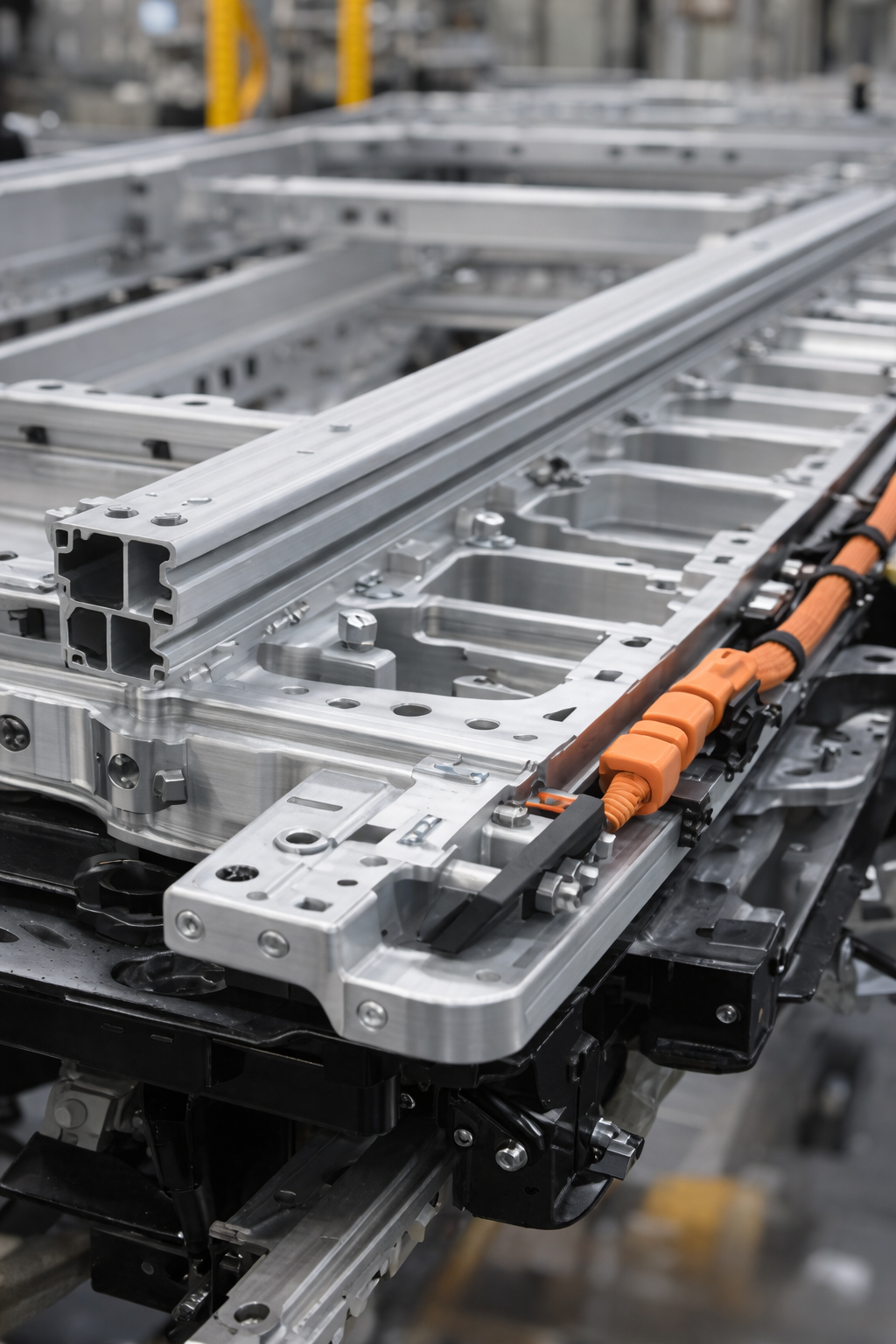
Electrification changed what these programmes ask for. Battery enclosures need structural sections that also manage heat and seal reliably, so the profile is simultaneously a structural member, a thermal path and a sealing surface. Those requirements are best resolved together, before the die is cut.
Volume then makes repeatability the whole problem. Multi-axis machining puts features on several planes in one setup, which removes the stack-up error that comes from re-fixturing, and in-process inspection holds the dimensions across the run.
A battery tray is a structural member, a thermal path and a sealing surface in one extrusion.
Materials and finishes
Profiles for every industry we serve are extruded from 6000-series alloys and finished in-house. The right combination depends on the loads, the environment and how visible the part is.
- 6063 and 6060
- General-purpose and detailed sections with excellent surface quality — the usual choice where the part is seen.
- 6061 and 6082
- Higher-strength structural alloys for load-bearing and safety-critical sections.
- 6005 / 6005A and 6463
- Structural sections needing more strength than 6063, and bright architectural trim.
- Anodized finishes
- Clear satin and etched, electrolytic colour and chemically bright, up to 27 ft in length.
- Painted finishes
- Durable indoor and outdoor coatings with consistent colour matching across runs.
- Mechanical finishes
- Buffing, brushing and deburring where a specific surface texture is required.
Key manufacturing capabilities
Dajcor Aluminum delivers engineered aluminum extrusion solutions backed by technical expertise, responsive service, and dependable North American manufacturing capabilities.
- Custom aluminum extrusions in 6000-series alloys
- Precision CNC machining and fabrication
- In-house anodizing and painted finishes
- Extrusion lengths up to approximately 28 feet
- Prototype through production manufacturing support
- Canadian and U.S. manufacturing capabilities
Key advantages
Capabilities behind this work
The in-house processes this market draws on most.
Common questions
Answers to the questions that come up most often at the quoting stage.
In many applications, aluminum extrusions can successfully replace steel components while offering several advantages.
Aluminum provides an excellent strength-to-weight ratio, meaning it can deliver structural performance while significantly reducing overall weight. This can improve efficiency in applications such as automotive, transportation, industrial equipment, and infrastructure systems.
Extrusion also allows engineers to integrate multiple design features—such as ribs, channels, and hollow sections—into a single profile. This can reduce part counts, simplify assembly, and lower overall manufacturing costs.
When evaluating a steel-to-aluminum conversion, factors such as load requirements, corrosion resistance, finishing needs, and fabrication processes should be considered. Our team works with customers during the design stage to help determine whether an aluminum extrusion is a suitable alternative for their application.
Aluminum extrusion tolerances depend on several factors, including the size and complexity of the profile, wall thickness, alloy selection, and the circumscribing circle diameter (CCD) of the extrusion. Industry standard tolerances are typically based on guidelines published by the Aluminum Association, which define achievable dimensional accuracy for solid, hollow, and semi-hollow profiles.
With Dajcor’s 7", 8" and 9-inch extrusion presses, we are able to produce a wide range of aluminum profiles that meet standard Aluminum Association tolerances across many applications. During the design and quoting stage, our team reviews each profile to confirm achievable tolerances based on the specific geometry and manufacturing requirements.
Working collaboratively during the design phase helps ensure the extrusion profile is optimized for manufacturability while maintaining the dimensional precision required for the application.
Dajcor Aluminum supplies custom aluminum extrusions to a wide range of industries that require lightweight, durable, and high-performance components. Our extrusions are used in applications across sectors such as:
- Automotive and transportation
- Electric vehicle (EV) components and electrification infrastructure
- Defense and aerospace support applications
- Construction and architectural systems
- Industrial equipment and automation
- Renewable energy systems
- Lighting and electrical systems
- Consumer and commercial products
By working closely with engineers and manufacturers, Dajcor helps develop extrusion solutions that improve product performance, reduce component weight, and simplify manufacturing and assembly.
Ready to build for automotive?
Tell us what you’re manufacturing and your target requirements. We’ll recommend the right approach and next steps for your automotive component.
Get in touch